Originally published in the FRAM Journal, 3rd Series No. 12, April 20011. There is also a display of artefacts from the railway in the Lanman Museum2.
Although the railway has closed, it lives on in model form.
By J. C. Simpson
In the first half of the nineteenth century, travel for ordinary people was restricted to horse, carriage, bicycle or on foot. Few people were rich enough to own a horse or carriage and therefore rarely strayed away from their home town or village. In Framlingham, an outing to the seaside or to Ipswich was a major event. It was the dawning of the railway era that allowed people to travel, and, more importantly, enabled goods to be transported quickly and relatively cheaply to new markets. Railways were initiated for the transport of goods, not people and it was as a secondary use that passengers were carried. The railways were particularly efficient at transporting bulky goods like stone or coal quickly over large distances and, as they developed, the carriage of manufactured goods.
In the 1830s and 1840s, there were many proposals for new railways. A Railway Bill had to be proposed in Parliament before a new railway could be built or finance sought for it. The flurry of speculation to make a quick profit must have been very like the present-day “dot.com.” companies. They showed spectacular growth in share price before any profit had been made. The reality of the situation dawns on investors later as some of these companies go under or have to be taken over to save them. In those days it was known as “Railway Mania”. There were more proposals for railway lines than were ever built. Towns did not want to be left out of this new mode of transport, and often proposed a railway to their nearest major centre because they had not been included in another company’s proposal. Many of these were simply to join on to an existing line, rather than being part of any grand design. Some were totally spurious and aimed at a gullible public wishing to invest in the latest technology.
The railway companies that were being formed in the 1840s thought that the line from Ipswich – Norwich – Lowestoft – Yarmouth would be all that was required, and did not want to venture into East Suffolk. The local population of the time did not accept this point of view, and the promotion of railways in East Suffolk was therefore left to the interested landowners and businessmen. The Earl of Stradbroke and Sir E. S. Gooch supported the line, but not all landowners wanted their estates cut in two. The then Duke of Hamilton opposed it and kept the railway out of Easton Park itself. Finally, however, the line was financed by Sir Samuel Morton Peto, the father of modem Lowestoft, and was built by Peto and Thomas Brassey, who was a large contract builder of railways. It ran from Ipswich to Yarmouth3, via Wickham Market and Saxmundham. It had all the characteristics of a rural line, but was regarded as a main line until 1962, when British Rail downgraded it, made much of it a single line, and closed half the platforms. The stations became unmanned halts. At one time, they (like Framlingham) would have boasted Station Master, clerks, signalmen, and a whole bevy of porters, the railways being major sources of long-term employment, albeit at modest wage levels.
Because some of the proposals for lines in North Suffolk had failed, some local businessmen had allied themselves with Peto to form the new railway in 1850. This line was 13.5 miles long and cost £150,000, and was incorporated as the Halesworth, Beccles and Haddiscoe Railway by Act of Parliament on 5th June 1851. In 1854, it changed its name to the East Suffolk Railway (ESR) in order to promote a link between Great Yarmouth and Ipswich4. This is of interest to us, as powers had already been obtained by then to open branches to Framlingham, Snape, Lowestoft and Aldeburgh. The total length of the ESR and branches was 53 miles. The line to Framlingham was built as a branch or feeder line to the “main” line, which it joined at Wickham Market.
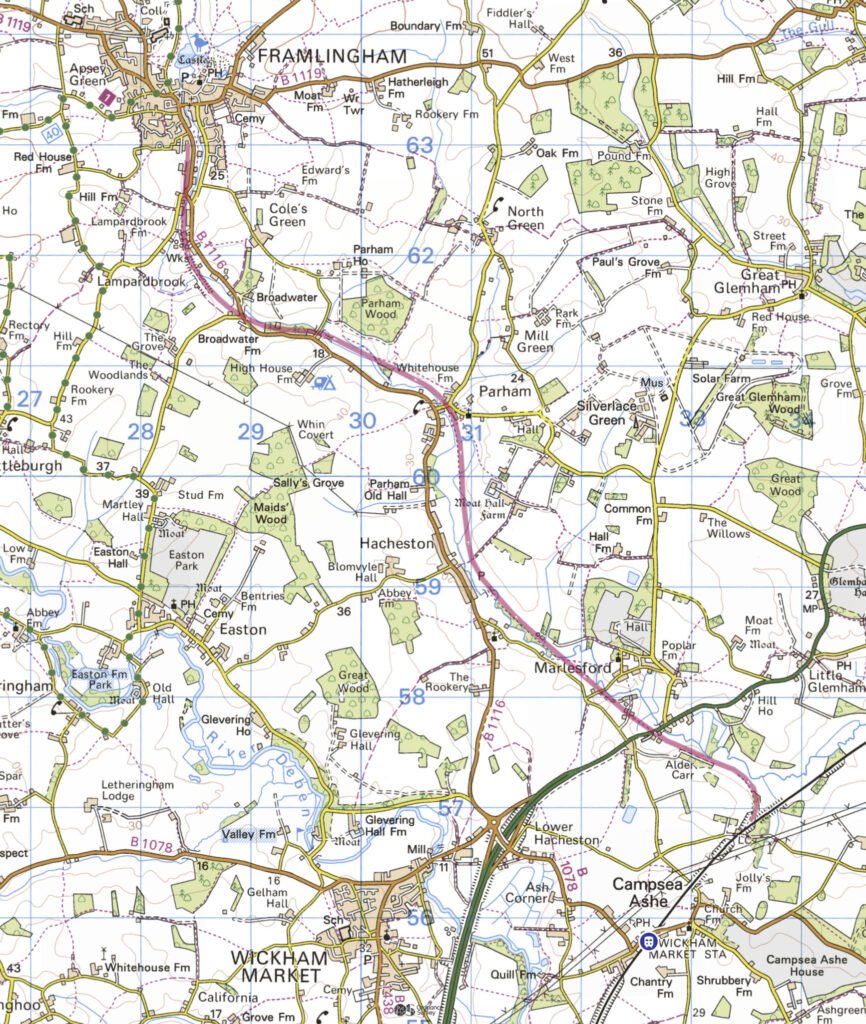
It was finally opened on 1st June 1859 along with the rest of the ESR except the Leiston and Aldeburgh branch. The line to Framlingham had stations at Parham and Marlesford. A halt at Hacheston was added much later in 1923 by the London and North Eastern Railway (LNER), to help make the timetable look better in the competition with the buses, which were newly emerging as cheap and quick passenger transport and to some extent starting to displace the railways. (The railways had, of course, displaced horses and carriages the previous century.) There was much rejoicing in the town when the first train arrived. The town band was on parade, but its conductor in his jubilation fell off the edge of the platform in front of the train. The driver managed to stop the train before running over the poor man, who also happened to be the Station porter.
In much the same way as we have a track and infrastructure provider today (Railtrack), with different operating companies providing and running the trains, a similar system was used with some, but not all, of the early railway companies. The Eastern Counties Railway owned and provided the trains to run on ESR’s own track. The initial service to Framlingham from Wickham Market was four trains a day each way. Passengers joining at Parham, Marlesford, and later Hacheston, had to buy their tickets from the Guard. This must have been one of the first lines in the country to have the “Conductor Guard” system.
On 7th August 1862, the East Suffolk Railway and its branches became part of the newly formed Great Eastern Railway (GER), when it amalgamated with the East Anglian, Eastern Counties, Nor folk and Eastern Union Railway Companies, plus their subsidiary undertakings. After the First World War, the Government of the day re-organised all the railway companies in Great Britain into four main groups on 1st January 1923. This was one step short of nationalisation, which came 25 years later. It cost the Government nothing and put the railways on a better financial footing after the War years, when the railways were heavily used but under-financed. The GER, including the Framlingham branch-line, was transferred to the London and North Eastern Railway Ltd. In organisational terms, things carried on very much as before, the GER part of LNER being somewhat autonomous, as indeed was the Eastern Region of British Rail later.
On 1st January 1948, the four railway companies were nationalised by the Clement Attlee Labour Government, and LNER passed into the hands of the British Transport Commission. The Commission was responsible for the railways nationally, for all the buses and trains in London, for road transport and for canals. Because of their many responsibilities, the Commission set up the Railway Executive to administer the railways. (A Railway Executive had existed to oversee the Railways during the war years). Framlingham branch and the main line to Lowestoft and Yarmouth became part of the Eastern Region of British Railways. The name was later shortened to British Rail, when the double-headed arrow logo was adopted.
Road haulage became very aggressive and competitive. Lorries were improving rapidly in technical specification and size. Railway pricing had long been a political football, and even in 1923, the Government had pegged the prices that the new railway companies could charge. The Railway Executive was not able to raise prices, and was bound by centrally negotiated wage bargaining. The Trade Unions were finding their feet, and the Road Haulage Association was lobbying hard the now Conservative Government. The road haulage industry had been de- nationalised (privatised as we would say today) and could charge what it liked and set about cherry-picking the most lucrative trade. It left the railways to pick up what they could with little investment, while still trying to recuperate after the War. The railways had been nationalised using loan-stock capital at 6% interest, which the Railway Executive had to find the money to pay out of its revenue. At the Railway Executive, there were committees beavering away .simultaneously in opposite directions. One was looking at cheapening branch line operations by using railbuses, while another was seeing which lines could be cut out to save costs. (This was long before the infamous Dr. Beeching arrived on the scene). Based on the decision-making processes of those days, lines like the Framlingham branch were doomed.
From a planning point of view, the line should have gone further into the town when it was built and not stopped half a mile outside. Framlingham did not have a large enough population fully to sustain n railway, and it survived for as long as it did because of the goods traffic. Large quantities of grain were exported from Framlingham, as were cattle in the early days.
Sugar-beet went by train from Framlingham to Ipswich sugar factory. My Grandfather issued the sugar-beet loading permits to the farmers, and doubtless was never short of a pheasant!
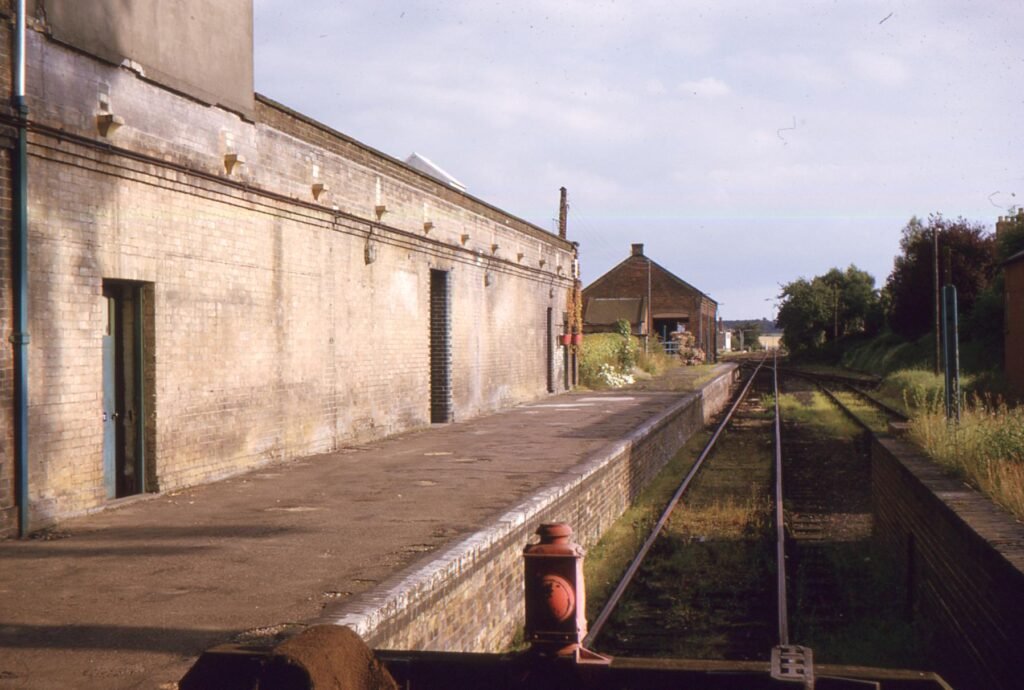
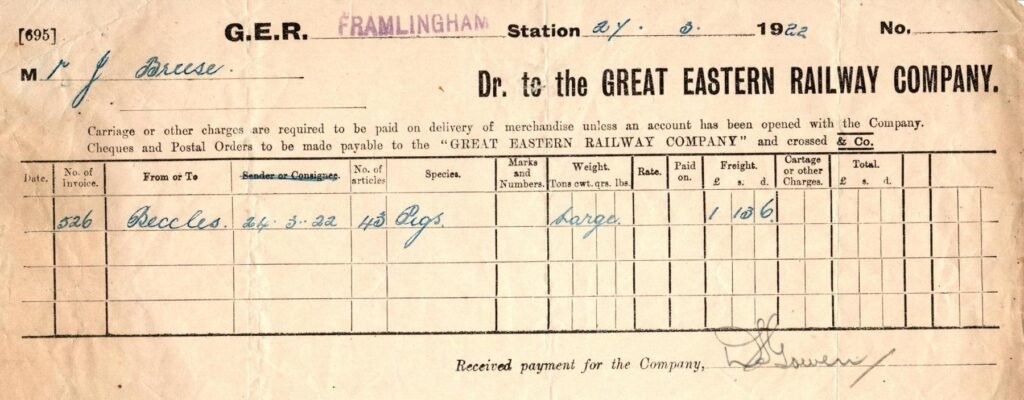
On 3rd November 1952, passenger services were withdrawn5. The. last train from Wickham Market ran on Saturday 1st November 1952. I was 14 years old and was on that train, but regret that I had to get off at Parham as we were staying with Percy and Kathleen Kindred at Parham that weekend. Freight traffic continued for nearly twelve years longer, but that service was finally withdrawn on 13th July 1964. Although passenger trains had stopped, special school trains for Framlingham College were run. They ran as ordinary passenger trains and anybody could travel on them with the boys, if they dared. On 19th April 1965, the line was closed in its entirety. During the summer of 1966, the track was lifted and the property disposed of. This was the beginning of the present use of Framlingham station. A steel hawser was put around the brick-built engine shed and with one quick pull by a locomotive, the whole building was demolished in seconds.
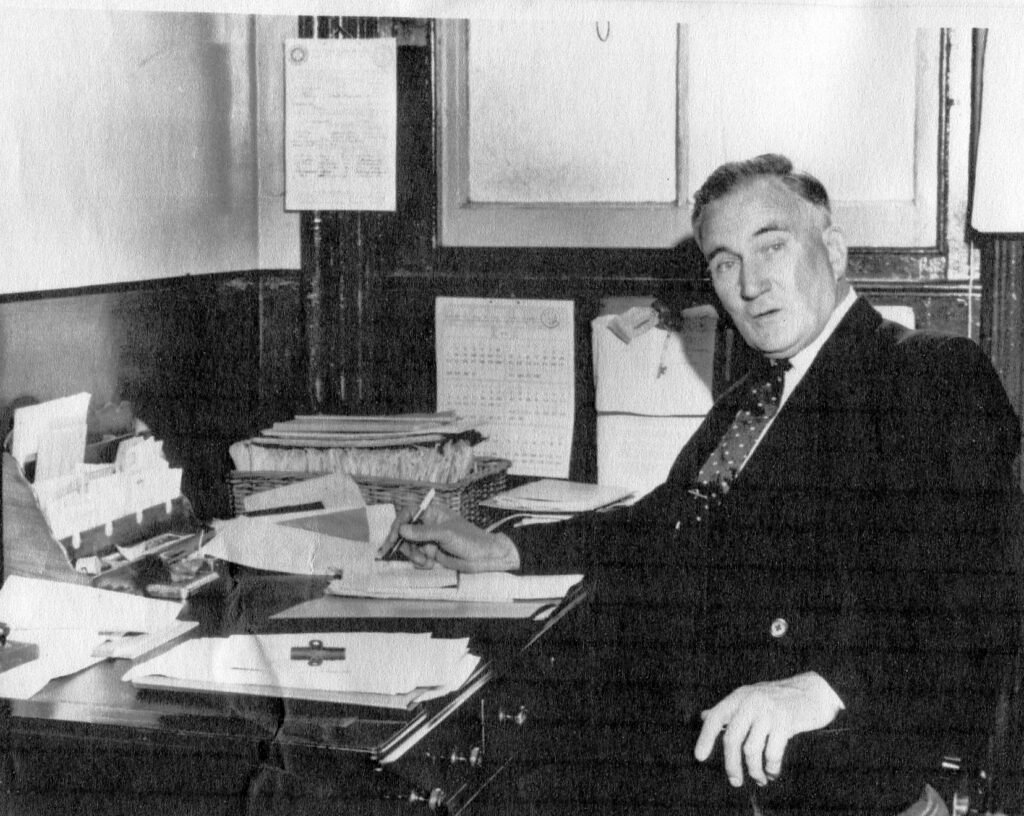
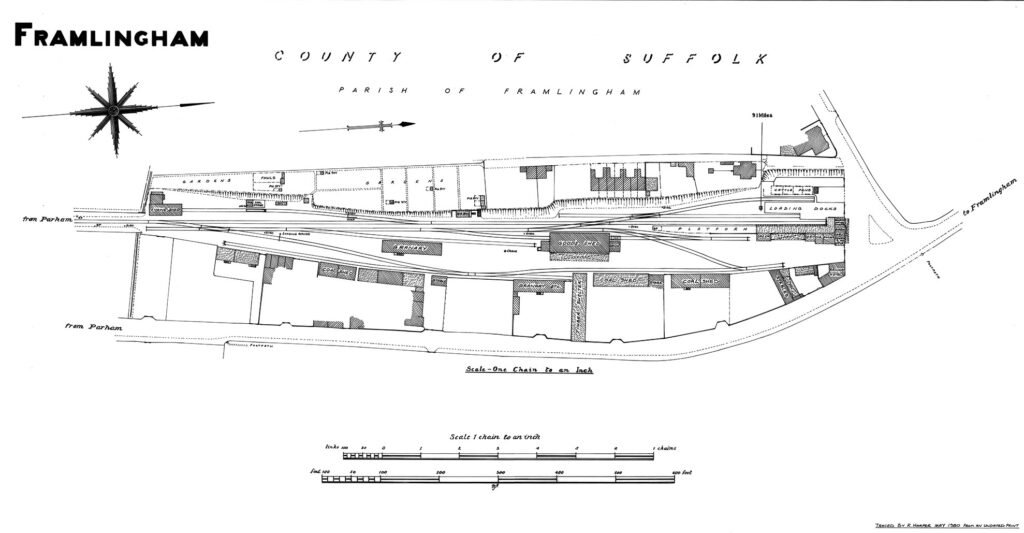
FRAMLINGHAM STATION. The station was built as a terminus with the provision of a single platform, a large goods shed, sidings to other commercial users, cattle penning and loading facilities. An engine shed for one engine was built, with the necessary coaling point and water tower. There was a signal box to control all train movements. Within the main station building was a booking hall that was approached from the large gravelled area outside the station where cars (or horse and trap) could stop. The door to the booking hall can be seen today, and is now part of the offices of the bed company that occupies land that used to be garden and cattle pens. To the right of the booking hall was the ticket office, where a full-time clerk worked. To the left of the booking hall was the Station Master’s office, with a door that led to the flat upstairs occupied by him and his family. Passengers passed though the booking hall onto the platform where the waiting rooms, lavatories etc. were situated. When trains came into the station, all the windows in the flat had to be shut as they were at locomotive chimney height.
PARHAM STATION. The station is two and a half miles from Framlingham and four from Wickham Market. In World War 2, a lot of extra traffic was carried in connection with the army and air-force establishments in the vicinity. (The most important one was the aerodrome at Parham, which to confuse everyone was known officially as Framlingham aerodrome, occupied by the United States Army Air Force. In 1943 its aircraft allocation consisted of 817 Flying Fortresses under Colonel Edgar M. Witton’s command of 390th Group (402 Air Bombardment Division). The Station Master’s House at Parham measures 34’8″ x 23’6″ on the upper floor and he had use of part of the group floor (15’9″x 23’6″). The remaining rooms are station offices etc. In 1892, the platform at Parham was extended. Parham had a signal box with a 20 lever Dutton frame, but the box was abolished in 1924 when the principle of “one engine in steam” on the branch line was adopted. After that, a small ground frame controlled the siding used for unloading coal and the transfer of other goods. It is believed that the siding was worked by James Pepper Frost, a flour and coal merchant.
MARLESFORD. Railway companies always sought to economise wherever they could, and using the same design for parts of the infrastructure was a common practice. Hence, the station buildings at Parham and Marlesford are identical. Two sidings were provided at Marlesford which were controlled by a 3-lever ground frame released by a key on the train staff. The signal box was abolished at the same time as the Parham box on 26th July 1924. To augment the station accommodation, a carriage body was placed on the platform beside the brick buildings. It arrived in 1902 and was a suburban third class brake No. 297, built to diagram 501 at Stratford works in 1874 at a cost of £260, one of 72 built between 1871 and 1876 for service on the Chingford and Enfield lines. It was withdrawn in December 1901. Its value then second-hand was £8. By the time the railway closed in 1965, electricity had not reached the station-house, and the well at the back of the house from which water was pumped daily had an unhealthy proximity to the cesspool. A single siding in the form of a loop was provided to service Messrs. Gooderham and Hayward’s Mill located south of the platform, completed at a cost of £303. Marlesford and the Junction had their hour of glory in May 1956 when the Royal Train was Stabled in the station overnight. A Class 814-6-0 No. 61252 was coupled up overnight to supply Steam heating. In the morning, the engine brought the train out onto the main line to be taken on to Lowestoft by No. 61399. The changeover was not faultless. HRH The Duke of Edinburgh put his head out of the window, saw Dr. lan Allen (a Framlingham GP of the time) standing by the side of the track and demanded to know what he was doing. The Duke was apparently satisfied with the reply that he was photographing the train.
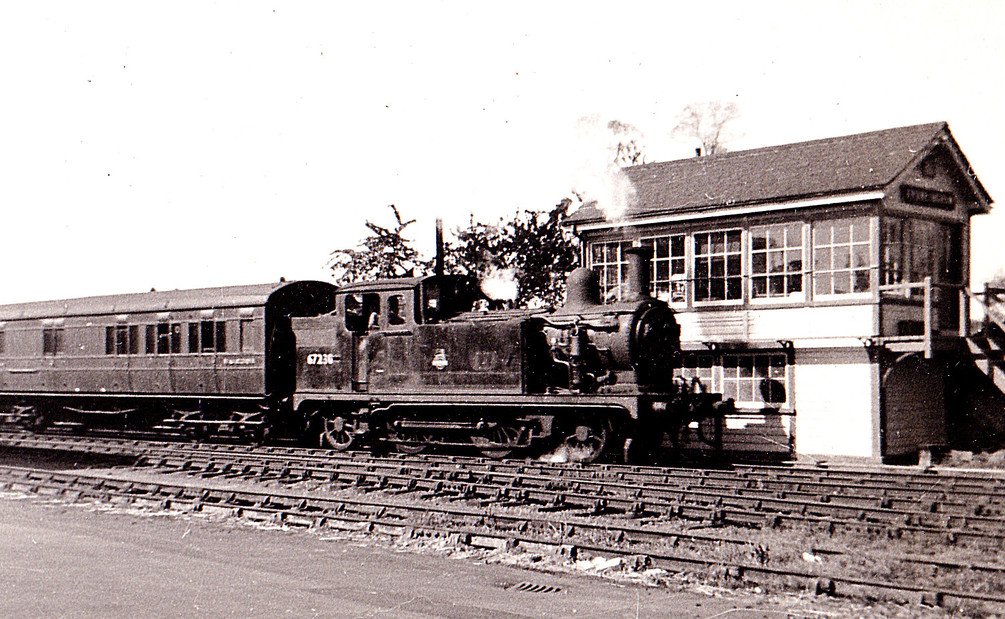
The trains at Framlingham were controlled from the one remaining signal box on the branch. A train arriving at Framlingham would always be engine-first, pulling two coaches and perhaps some mineral or goods wagons. When everybody had left the train it would reverse up the line for about 100 yards and uncouple. The engine would then be driven forward again, the points would be changed, and the engine would run round its train and then reverse up to the other end and recouple. This procedure was repeated at Wickham Market, so that the train was always pulled; special permission had to be sought if it was to be pushed. Nowadays the engine at the rear pushes many high-speed trains, although there is a driving cab at the front. There was no turn-table at Framlingham (nor at Wickham Market), so the locomotive, although at the front of the train, would travel engine first in one direction and tender first on the reverse run. It was always the practice to keep two spare carriages at Framlingham, which could be drafted into service if there was a special need.
At Wickham Market, the platforms were not opposite each other but in GER/LNER fashion were offset from each other, and only joined by a sleeper crossing for staff and trolleys, and a footbridge for passengers. There was a similar arrangement at Saxmundham. The station at Wickham Market was a misnomer. “Wickham Market for Campsea Ash” station was the official title, but it should really have been named “Campsea Ash for Wickham Market”, as the town was a couple of miles away, and the station was at Campsea Ash. Politics, I suspect, played a large part in the naming of the station, especially if they had been trying to raise money to build the railway from the residents of Wickham Market.
On 28th December 1860, only 18 months after the line opened, there was a highway robbery. “Booking clerk Swann and Lad Porter Lawrence were committed for trial on a charge of robbery with violence upon a blacksmith from Kettleburgh between 11 p.in. and midnight on 23rd December. Inquiries to be made”. (A Minute from the ECR Traffic, Locomotive and Permanent Way Committee.)
My grateful thanks to the following people and references without which much of this would have been impossible:-
- Family correspondence and photographs including Miss Mary Simpson, now aged 93.
- John Bridges, Little Waldingfield
- Public Record Office, Kew
- General Register Office
- Great Eastern Railway Society (various publications)
- J. M. Cooper, The East Suffolk Railway (1982).
- L. 0ppitz. East Anglian railways remembered (1989)
- R. Adderson and G. Kenworthy, Ipswich to Saxmundham (2000)
- Railtrack plc
- National Railway Museum, York
- Suffolk Chronicle and Mercury
- East Anglian Daily Times
- J. Booth, Framlingham College: the first fifty years (1925)
Footnotes
- See https://framlinghamhistory.uk/wp-content/uploads/2024/12/FRAM-Series-3-no-12-Apr-2001-MergedPDF.pdf for this edition of the Journal. All editions can be found at https://framlinghamhistory.uk/newsletters-and-journals/. ↩︎
- For more information about the line and about artefacts on display in the Lanman Musem, see this article. ↩︎
- The author states that the northern extent of the proposed line was Yarmouth. It was in fact Lowestoft. There was subsequently a line built between Lowestoft and Great Yarmouth, which opened in 1903. This rarely carried much traffic, and was closed in 1970. Before it opened, and after it closed, a rail journey from Lowestoft to Great Yarmouth involved a train to Reedham, and then a second train to Great Yarmouth. ↩︎
- As previously mentioned, the East Suffolk Railway, and the Act that enabled it, were for a line between Ipswich and Lowestoft, not Great Yarmouth. ↩︎
- The line lives on in model form. See https://www.youtube.com/watch?v=QZXppmhV4QI. ↩︎